Electrical & Computer Engineering Newsletter: August 2023

Electrical & Computer Engineering Newsletter: August 2023

Message From the Chair

Golden Knights in the Electrical & Computer Engineering Department change the world. This issue of our newsletter offers an array of stories that exemplify the impactful work members of our community do in all stages of their careers.

— Paul McGrath, Professor/Chair of Electrical & Computer Engineering

Future in Research

Image
Daqing Hou and Yu Liu

An NSF grant will fund 10 students per summer in the Research Experiences for Undergraduate program for another three years. The students work closely with faculty mentors to investigate novel high-performance computing solutions for a variety of engineering problems that are critical to national security, scientific discovery and technological innovation.

Read More About the NSF Grant for Our REU Site

Alumnus Address

Image
Headshot of Rajan Raghavan

Rajan Raghavan MS’82 keynoted May's graduate commencement ceremony. A serial entrepreneur, Raghavan is a University trustee and founder of The Fabric, which co-creates cloud infrastructure companies with other entrepreneurs.

Read More About Rajan Raghavan's Commencement Address

Prof in Japan

Image
Prof. Dana Barry presents at a podium

Prof. Dana Barry traveled to Japan to provide women with tips for pursuing research opportunities. She also shared her unique and creative career experience with students.

Read More About Prof. Barry's Japan Trip

Top ROI

Image
B.H. Snell Hall, Clarkson University

Clarkson is consistently named a best-value college known for giving students a great return on their investment. We recently placed in the Top 40 on Stacker’s list of the 100 colleges whose grads go on to earn the most. The Stacker rankings, compiled using PayScale data, also highlighted that Clarkson grads report salaries more than 10 percent higher than the national average.

Read About Our Great ROI

Chemical & Biomolecular Engineering Newsletter: August 2023

Chemical & Biomolecular Engineering Newsletter: August 2023

Message From the Chair

Golden Knights in the Chemical & Biomolecular Engineering Department change the world. This issue of our newsletter offers an array of stories that exemplify the impactful work members of our community do in all stages of their careers. Please enjoy reading.

— Elizabeth Podlaha-Murphy, Professor/Chair of Chemical & Biomolecular Engineering

Plasma Pathways

Image
Selma Mededovic

Prof. Selma Mededovic and her co-researchers have received an NSF grant to further research into the development of multiphase gas-liquid plasma reactors. The nearly $800K in funding could generate new insights and novel means of analyzing plasmas in contact with liquids.

Read More About Prof. Mededovic's NSF Grant

Nitrogen to Ammonia

Image
Headshot, Ian McCrum

The transition to clean energy technology has stimulated research into alternative energy sources and the development of electrocatalytic processes. Asst. Prof. Ian McCrum was awarded an NSF Engineering Research Initiation grant for research on a reaction in which renewable electricity can be used to convert atmospheric nitrogen and water into ammonia, a widely used fertilizer.

Read More About Prof. McCrum's NSF Grant

Civil & Environmental Engineering Newsletter: August 2023

Civil & Environmental Engineering Newsletter: August 2023

Message From the Chair

In this issue of our newsletter, we share just a sampling of recent achievements of the students and faculty in the Department of Civil & Environmental Engineering. Our faculty are dedicated to improving the resilience of both the built and natural environments and to mentoring the next generations of engineers by sharing their knowledge.

— Steven Wojtkiewicz, Professor/Chair of Civil & Environmental Engineering

Kicking Up A Virus

Image
Portrait of Mahender Singh Rawat

PhD student Mahender Singh Rawat's research is the first study that has quantified the resuspension, or “kicking up," of virus particles from the floor into the air from human activity. He was awarded a grant to attend the International Society of Exposure Science annual meeting and present his research this summer.

Read More About Kicking Up Virus Particles

Fulbright Specialist

Image
Robert Thomas

Concrete construction is responsible for more than seven percent of global carbon dioxide emissions, but Assistant Professor Robert Thomas and his research team are working to change that. He received a Fulbright Specialist award to travel to India this summer and collaborate on curriculum development to support emerging low-carbon concrete technologies.

Read More About Prof. Thomas' Fulbright

Healthy Water

Image
Two men discuss a poster presentation.

Clarkson's Center of Excellence in Healthy Water Solutions held its first annual meeting during the spring semester. The conference addressed topics like building climate resiliency in small communities, the treatment and monitoring of forever chemicals such as PFAS, and the detection and mitigation of harmful algal blooms.

Read More About the Health Water Solutions Meeting

Ice Award

Image
Headshot, Hung Tao Shen

Distinguished Research Professor in Hydraulic Engineering Hung Tao Shen has been honored for his outstanding and sustained contributions to the advancement of river ice science and engineering in Canada. In July, he received the Bernard Michel Award of the Committee on River Ice and the Environment of the Canadian Geophysical Union.

Read More About Prof. Shen's Award

Center for Advanced Materials Processing Newsletter: August 2023

Center for Advanced Materials Processing Newsletter: August 2023

Message From the Director

Our CAMP-affiliated faculty continue to make ground-breaking discoveries in their research. From finding new ways to remove toxic PFAS from groundwater to analyzing plasmas in contact with liquids, we are breaking new ground as we look for ways to keep our world clean. Here are a few of their stories.

— Devon Shipp, Director of CAMP, Professor of Chemistry & Biochemistry

Plasma Pathways

Image
Selma Mededovic

Prof. Selma Mededovic and her co-researchers have received an NSF grant to further research into the development of multiphase gas-liquid plasma reactors. The nearly $800K in funding could generate new insights and novel means of analyzing plasmas in contact with liquids.

Read More About This NSF Grant

Sensing PFAS

Image
water is being poured into a glass adjacent to other half-full water glasses

Per- and polyfluoroalkyl substances (PFAS) – synthetic chemicals used in many industries and products – are of growing concern because of their harmful effects on the environment and human health. Research into developing easy-to-use, low-cost sensors for PFAS was recently highlighted in Chemical & Engineering News.

Read More About Sensing PFAS

Removing PFAS

Image
Richard Partch, Silvana Andreescu, Mario Wriedt, Thomas Holsen, and Michelle Crimi

A group of professors has been awarded $650K from the Department of Defense Strategic Environmental Research and Development Program to find and design new advanced adsorbent materials to remove toxic per- and polyfluoroalkyl substances (PFAS) from groundwater.

Read More About Removing PFAS From Groundwater

CAMP Meeting

Image
four attendees, including Devon Shipp and Marc Christensen, at the CAMP Technical meeting.

More than 160 scientists, industry leaders, state economic development representatives and students gathered for the 2023 CAMP Annual Technical Meeting in Corning, New York. The meeting featured a research and technology showcase as well as themes revolving around advanced characterization of materials and advanced technologies for healthy water.

Read More About the CAMP Technical Meeting

Mechanical & Aerospace Engineering Newsletter: August 2023

Mechanical & Aerospace Engineering Newsletter: August 2023

Message From the Chair

National research grants awarded this year to Department of Mechanical & Aerospace Engineering faculty by the NIH and NSF are enabling both our undergraduate and graduate students to engage in groundbreaking research and scholarship. From cutting-edge biomedical research to studying the solar birthplace of space weather, our students are performing the hands-on research at the center of the Clarkson experience.

— Brian Helenbrook, Professor/Chair of Mechanical & Aerospace Engineering/Paynter-Krigman Endowed Professor in Engineering Science Simulation

Vocal Hyperfunction

Image
headshot, Byron Erath

Mechanical & Aerospace Engineering students will perform cross-disciplinary biomedical research along with more than 25 researchers from more than 13 universities and institutions around the world. Associate Professor Byron Erath is a co-investigator in the National Institutes of Health grant which is making this possible.

Read More About Vocal Hyperfunction

Glowing Opportunity

Image
Student working on research

Clarkson has a strong history of welcoming socio-demographically diverse students to our campus. A National Institutes of Health grant will launch the BOREALIS Scholars program, which will prepare a diverse cadre of students for careers in biomedical research by creating a pathway to bioengineering graduate study.

Read More About the BOREALIS Scholars

Solar Convection

Image
Chunlei Liang

The sun’s convection zone is the birthplace of space weather. Through a National Science Foundation grant, Professor of Mechanical and Aerospace Engineering Chunlei Liang will teach graduate, undergraduate and high school students how to become computational engineers and scientists who can make faster and more accurate predictions of turbulent convection in the sun.

Read More About Prof. Liang's Project

Top ROI

Image
Snell Hall

Clarkson is consistently named a best-value college known for giving students a great return on their investment. We recently placed in the Top 40 on Stacker’s list of the 100 colleges whose grads go on to earn the most. The Stacker rankings, compiled using PayScale data, also highlighted that Clarkson grads report salaries more than 10% higher than the national average.

Read More About Students' Earnings

Construction Engineering Management (CEM) Programs

Construction Engineering Management (CEM) Programs

Construction Engineering Management (CEM) Programs

Construction Management Highlights & Opportunities

Clarkson CEM Consulting Group

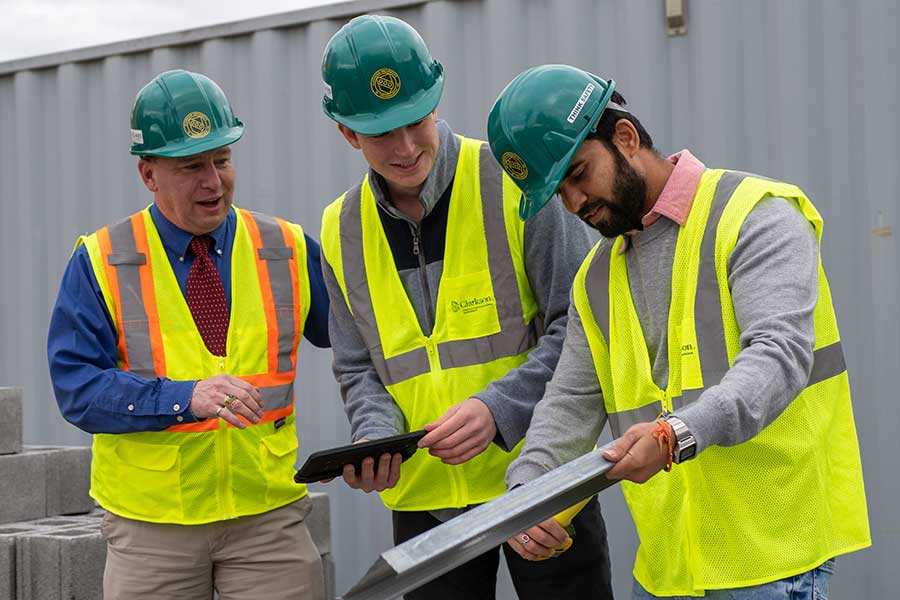
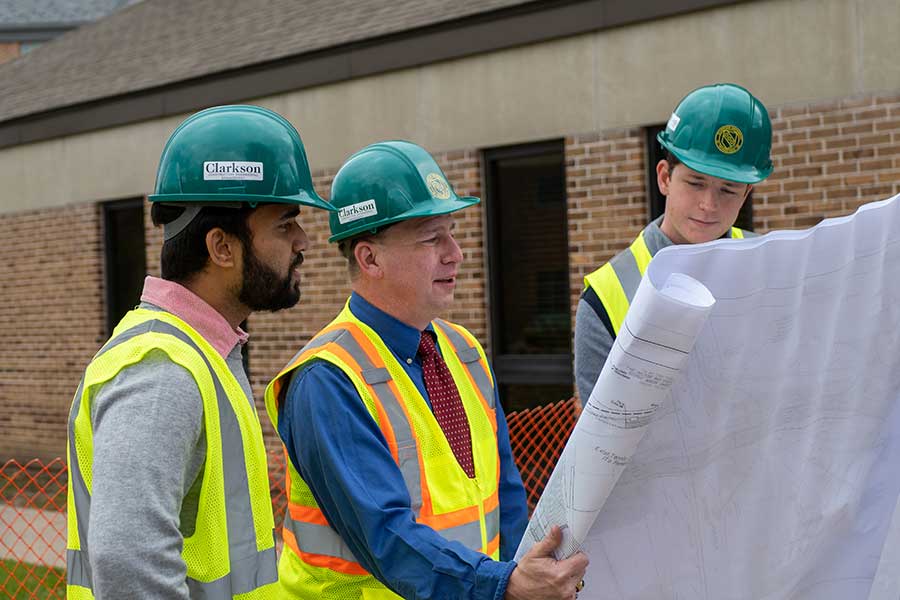
The Clarkson CEM Consulting Group (C3G) is an in-house Clarkson University capability that provides pre-professional consulting in planning, engineering, and construction areas.  This business enterprise uses students in an experiential learning mode in order to deliver products that the targeted market segments would not be otherwise able to conduct these efforts using professional consulting services. 

Learn More About C3G

Exploring Sustainability


Read about the Clarkson students who traveled to Washington, DC to observe sustainable building practice and build connections.

Read the blog

Scholarships and Recognition in National and Regional Professional Societies Competitions

Every year the CEM faculty advertise, encourage and support student applications across the Civil and Environmental Engineering (CEE) Department to both the national Associated General Contractors (AGC) of America and the AGC NYS competitions. What is especially significant is that Clarkson students were awarded seven of the 22 scholarships given out by AGC NYS in 2022, roughly a third, from all the civil engineering, construction technology, and construction management student applicants across New York State. Clarkson students are often selected to be a part of the American Society of Civil Engineers – Construction Institute (ASCE-CI) “Student Days” competition held each summer.

2023-24 Clarkson Scholarship Awardees

CEM Microcredentials

Clarkson's Construction and Engineering Management program works closely with Turner Construction on a series of Microcredentials for students and employees of the company. As a member of the Advisory Board for the program, Turner gives students the opportunity to learn alongside professionals in short courses designed to teach real life problems seen on actual job sites. At the end of each Microcredential, students are presented with a digital badge that validates the skills they have learned and gives them the chance to apply their knowledge in a workforce setting. Watch our video to find out more!

Meet the Pro of the Knight

The Construction Engineering Management (CEM) Program seeks to engage our students with real-life, hands-on experiences and learning opportunities. As part of those efforts, the CEM program invites a variety of industry leaders to be the “Pro of the Knight.” Typically featuring four per semester, these professionals talk candidly with students about their background, knowledge and experiences in the construction industry, providing invaluable tips and advice for entering the field.

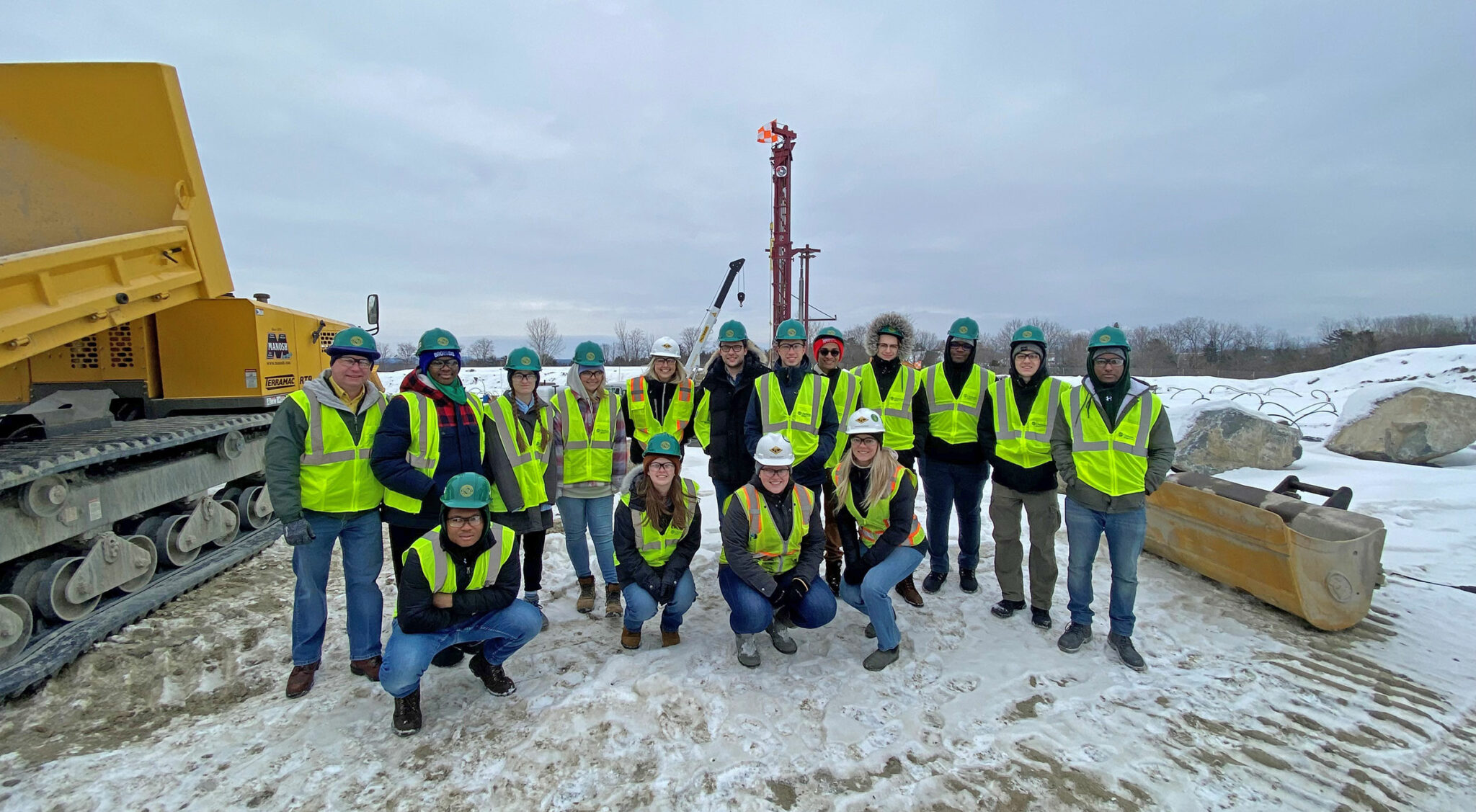
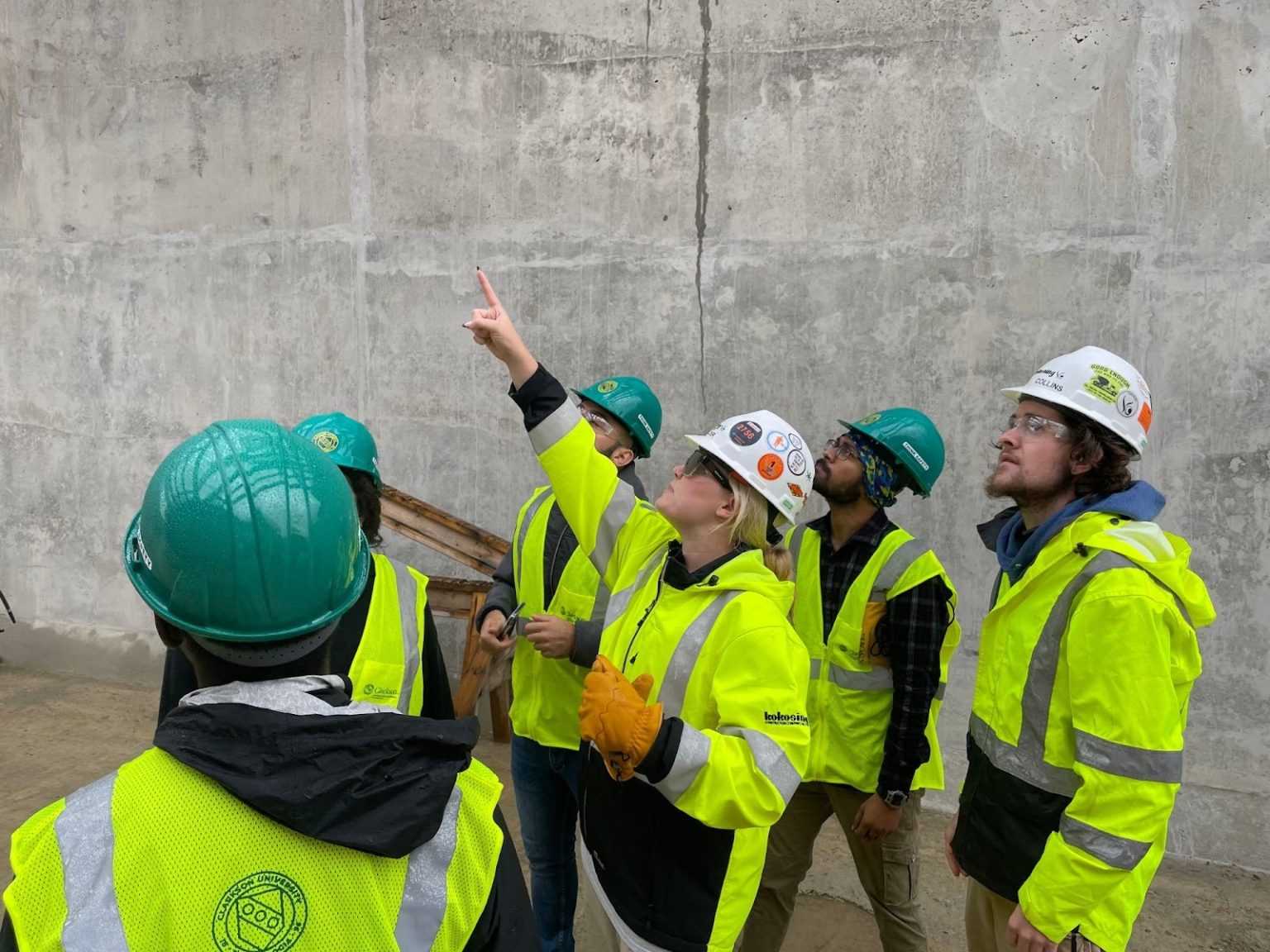
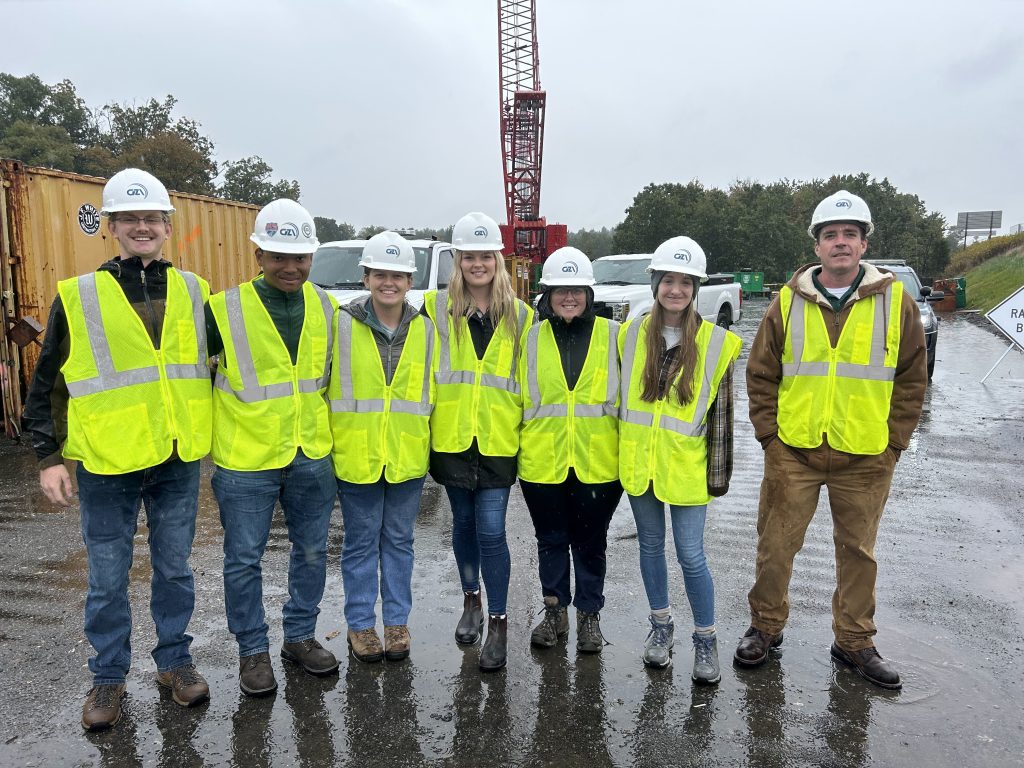
Project Site Visits

The Clarkson CEM program at the undergraduate and graduate level is among the best in the nation. Our students are sought after by many top firms because of the training, knowledge, and professional development they receive while earning their degree at Clarkson.  Each semester, students at all levels have the opportunity to visit building and infrastructure projects that bring the classroom into context and real-word applications.

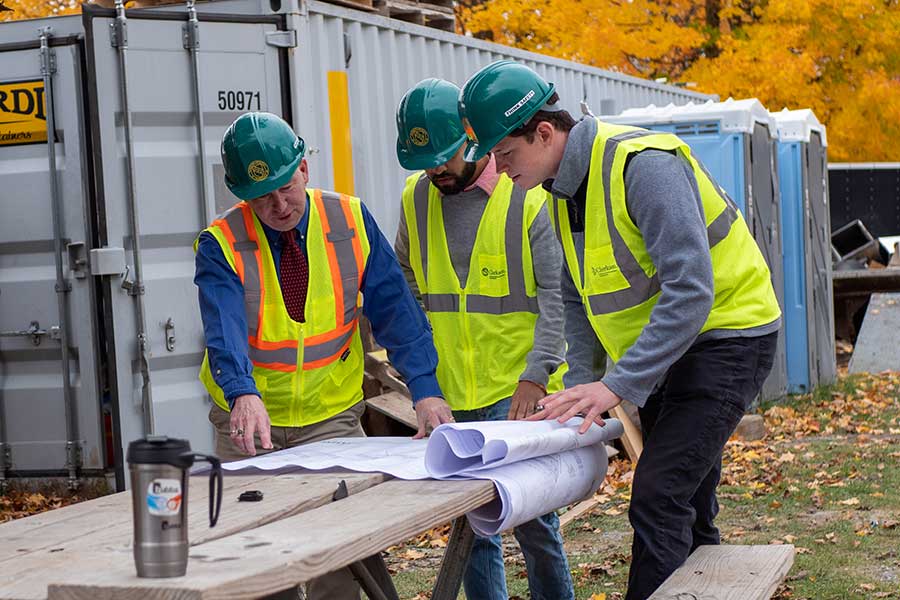
Canton-Potsdam Hospital Construction Site Visit

Significant Gifts and Contributors to Clarkson CEM

Howard E. Lechler was a well-known long-time Clayton and Gouverneur, New York resident who was born in Chicago, served in the US Army during WWII, and graduated from Clarkson University in May 1948 with a Bachelor of Science in Civil Engineering degree. Howard began his career as a Professor of Civil Engineering at Clarkson in 1948. John Rouse interviewed several candidates and saw Howards' management potential to start up the highly successful and now very large, multi-location, steel fabrication enterprise known today as Cives Steel Company with headquarters in Alpharetta, Georgia. Cives Steel, his life’s work, is one of the largest steel fabricators in the United States with six fabrication facilities strategically located throughout the US.

Howard went on to earn a Master of Science Engineering degree from Clarkson in 1953 and received an Honorary degree from Clarkson in 1978. In 2016, Clarkson was honored to receive a gift to endow the Construction Engineering Management (CEM) program’s director position in perpetuity. The CEM Program at Clarkson honors Howards’s legacy as a highly successful businessman, an avid sailor, hunter and fisherman, though a seat on the CEM advisory board for the Lechler/Cives Steel family as well as its commitment to the very best in construction education regionally and nationally.

Ronald P. Wells ‘68 received a bachelor’s degree in civil engineering from Clarkson College of Technology and led an extraordinary construction career, which began in 1968 with Peter Kiewit Sons’ Company. For the next twenty years, he worked in management capacities, from engineer to Vice President, building highways, bridges, industrial work, and heavy civil-related construction projects. In 1990, he became Vice President of Operations for Dillingham’s North American operations and simultaneously was President of Dillingham, Canada. After 30 years, Ron took on a new role as President and CEO of Stacy & Witbeck, Inc. Under Ron’s leadership, the firm grew from a regional construction company to a nationwide industry leader constructing light rail, commuter rail, streetcar, and other heavy civil transportation construction projects.

Ron was a proud leader of several construction industry associations, including The Beavers, and The Moles. He was also a member of the Good Knights Guild, Clarkson University's donor recognition program. He was both a loyal and leadership donor. Through his generosity, several critical efforts were accomplished including the hiring of its first Construction Engineering Management (CEM) Director, expansion of curriculum, a new emphasis on internships and placement, establishment of the CEM Advisory Board, and recognition of the Clarkson CEM Program throughout the construction industry. In memory of Ron, for his leadership and generous support of the Clarkson Construction Engineering Management program, in 2024 Clarkson named the CEM Director’s office in his honor. 

Sandy Ginsberg ‘54, HD ‘07 from Brooklyn, New York, graduated from Clarkson University in 1954 and was awarded an honorary doctorate in 2007. Sandy served in the Marine Corps Reserve and worked in the Construction Management industry as a Civil Engineer and Construction Executive. He was a life member of American Society of Civil Engineers, and a former president of Clarkson Alumni Association. His storied career spanned rebuilding and preserving some of America's most notable landmarks, including the Statue of Liberty and Ellis Island. In 1995, he received the Ellis Island Medal of Honor, recognizing his contributions to The American-Scandinavian Foundation, The American Scandinavian Society and Sons of Norway. In 2018, Clarkson University established a unique fund to perpetually resource and enable all expense paid field trips for students, often in partnership with CEM advisory board members and corporate partners.

Corporate Partners

The Clarkson CEM program at the undergraduate and graduate level is among the best in the nation with a consistent 100% year over year placement rate of our graduates in the construction industry.  Our strong relationship with partners provides many opportunities for our students and assurance our students are graduating with the skills needed to be ready to enter the workforce.  Our students are sought after by many top firms because of the training, knowledge, and professional development they are known to receive while earning their degree at Clarkson

Image
Compilation of company logos that support Clarkson's engineering program.

Contact the Construction Engineering Management Program

cem@clarkson.edu, (315) 268-4017

Erik C. Backus, Ph.D., P.E., LEED AP BD+C, ENV SP, FMP
Professor of Practice & Howard E. Lechler ’48, MS ’53, HD ’78 Endowed
Director
ebackus@clarkson.edu

Donna Kowal, Program Manager
dmkowal@clarkson.edu


Follow us!
LinkedIn: Clarkson CEM Program
BlueSky: clarksoncem 
Instagram:  clarksonconstengrmgmt
Facebook: ClarksonCEM
X:  @ClarksonCEM


Rattleback Top

Rattleback Top

The rattleback is a top that defies convention.

It spins freely in one direction, but if spun in the other direction, its rotational motion becomes unstable; it starts to wobble and then will begin to spin in the opposite direction. In this regard, the rattleback seems to defy the physical law of conservation of angular momentum.

The rattleback is shaped as an elongated asymmetric semi-ellipsoid with a flat top. The unintuitive reversal of the rotational motion occurs because of its asymmetry. The asymmetry of the rattleback and frictional force from the table surface cause the rotational motion of the rattleback to become unstable. The friction transfers energy from the spinning (rotational energy) to the wobble (vibrational energy). The vibrational energy is then transferred back to rotational energy but in the preferred direction. Rotation in the preferred direction can also be initiated by pushing down on one end of the rattleback. This vibration is then transferred to a rotational energy.

The rattleback provides an opportunity to demonstrate many physics concepts in the classroom.

What are the axes of rotation? 

The rattleback has three primary axes of rotation. It can spin about its center vertical axis. It can roll about its horizontal long axis, and it can rock or wobble about its horizontal short axis. In boating terms, these are called yaw, roll and pitch.

  • Have your students identify these axes and sketch the shape of the rattleback in each case. The asymmetry in the shape can be seen when you look at the rattleback along the line of the long horizontal axis.

Why isn’t angular momentum conserved? 

Conservation of angular momentum is really just a special case of Newton’s second law of rotation when there is no net external torque (force applied at some distance from a rotation axis). In the case of the rattleback, however, there is a torque caused by the friction from the table top.

  • Try spinning the rattleback on various surfaces to illustrate the importance of friction.

What is Newton’s second law of rotation? dtLdext=Στ [1]

Angular momentum (L) is only conserved when there is no net external torque (∑Ŧext=). In the rattleback case, the torque comes from the frictional force, which acts in a direction opposite to the direction of the spinning. Angular momentum depends on the angular velocity (ω) and the rotational inertia (I): 

ωIL= [2] where ∑=iidMr2 [3]

The rotational inertia is defined by the distribution of mass (M) at a distance r from the axis of rotation. In rotation, objects behave differently based on the distribution of mass about the axis of rotation.

  • You can demonstrate this with a simpler example than the rattleback:      
    Take two PVC pipes of equal length. Add a high density material (like clay or steel washers) to the middle section of one. Divide the same mass in half and add equal parts to the end sections of the second pipe. The pipes will weigh the same, but the distribution of the mass      
    and, therefore, the rotational inertia will vary.
  • Have students quickly rotate the pipes back and forth (by gripping them at the middle) and describe the differences in their movement. Which is harder to rotate?

How does stability come into play? 

Objects in rotation preferentially spin around the axis with the smallest rotational inertia (eqn. [3]). Try spinning a book-sized block of wood in the air to demonstrate this. Spinning the wood around the longest or shortest axis of rotation is stable and the wood continues to spin. However, it wobbles when spun around the intermediate length axis.

The rattleback is more complicated in its instability due to the asymmetry around the axis with the smallest rotational inertia. However the instabilities are demonstrated when you tap the end of the rattleback. In this case, you are rotating the rattleback around the intermediate axis (short horizontal axis), which is the most unstable, similar to the book example. The wobble (rotation about the intermediate axis) is unstable and turns into rotation about the axis that is most stable.
 

Physics at Work

The rattleback is a great example of physics at work and the complexities of describing what appears to be a simple toy. Researchers have worked over decades to describe the motion of the rattleback in both physical and mathematical terms. Complicated mathematical equations and numerical models have been developed to simulate this behavior. But physicists who try to describe the physical behavior still struggle to intuitively understand it! The world’s most pressing problems in science, medicine, engineering and our natural environment are complex in much the same way.

References:

Physics

http://www.4physics.com:8080/phy_demo/rattleback.htm
Walker, J. The Flying Circus of Physics, 2nd ed., Wiley, 2007
(www.flyingcircusofphysics.com)

Crane, H.R. “How things work: The rattleback revisited.”
The Physics Teacher, 29(5):278-9, 1991.


Simulations

http://www.tu-chemnitz.de/ifm/english/e_ifm_ala4bsp_rattle.htm
http://www.autolev.com/WebSite/SampleProblemRattleback/Rattleback.html

History

http://128.174.130.156/LectDemo/descript/1148/more%20info.html
http://en.wikipedia.org/wiki/Rattleback

Office of Information Technology

Office of Information Technology

Office of Information Technology

The Office of Information Technology (OIT) provides the IT infrastructure, services and support necessary to advance Clarkson University’s teaching, research and service missions. Comprised of four primary groups — Academic Technology and Support, Administrative Computing, Network Services and Information Security, and Web Development — we are here to support your growth and success at Clarkson.

Contact Us

HelpDesk

Phone: 315-268-HELP
Email: helpdesk@clarkson.edu
In-Person: 2nd Floor, Educational Resources Center

Office of Information Technology

Vice President for Information Technology: Joshua A Fiske
Read: Clarkson's Documentation Library

Services and Resources

Access reliable digital and technology support. 
Reach out to our office — or have us come to you.


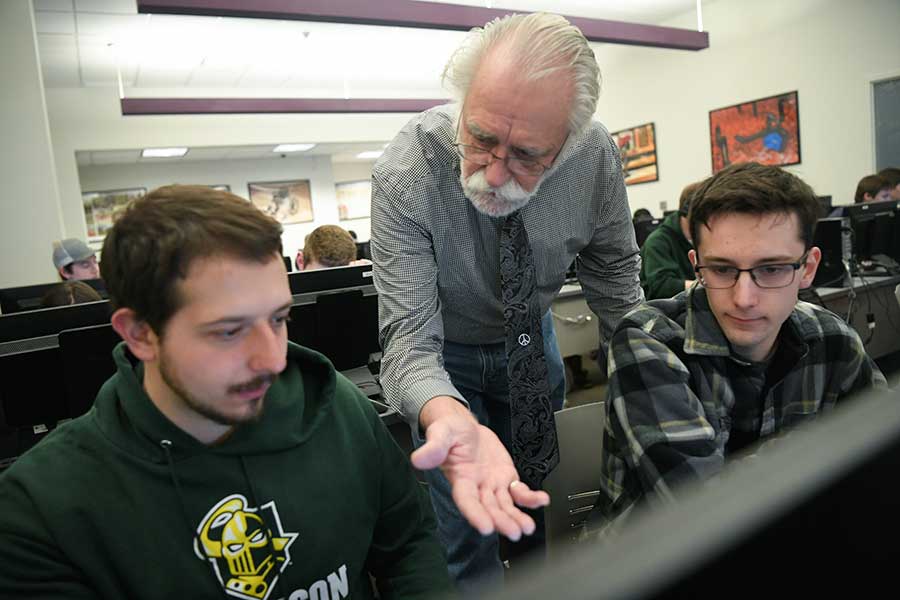
Students and a professor in a computer lab

Computer Labs

Clarkson has eight computer labs with more than 300 computers across campus, available 24/7. These workstations are all connected to Clarkson’s high-speed network backbone to ensure unimpeded access to research and learning platforms.

Individual using a phone with a wireless symbol displayed

Wireless Access

Access a secure Wi-Fi network in all indoor locations on campus, including residence halls, academic spaces, dining halls, our libraries, athletic facilities, study spaces and more locations. Students in all of the University’s residence halls can connect wirelessly and via Ethernet.

Individual using a laptop and phone

Communication and Publishing

The Office of Information Technology manages several website and communication services, including clarkson.edu, intranet.clarkson.edu, daily announcements and web services for clubs, teams and organizations.

Individual holding a laptop out for someone to take

Loaner Equipment

OIT maintains a pool of loaner equipment designed to meet the need for short-term, unanticipated computer hardware. If your laptop is broken and needs to be sent out for repairs, we are happy to loan you a computer for a few weeks!

Individual signing into a website on a laptop

Accounts

Your single sign-on (SSO) account seamlessly connects you with all IT platforms on campus, including your Gmail, myCU, Moodle, public lab computers, printing, library services and more.

Laptop with a headset over the screen

Help Desk

Stop by the Help Desk, located on the 2nd Floor of the Educational Resources Center. Walk up, call or email us for support or questions about any IT-related issues. The Help Desk is available Monday – Friday, 7:30 a.m. – 4:30 p.m. Summer hours vary.

An individual working on a computer

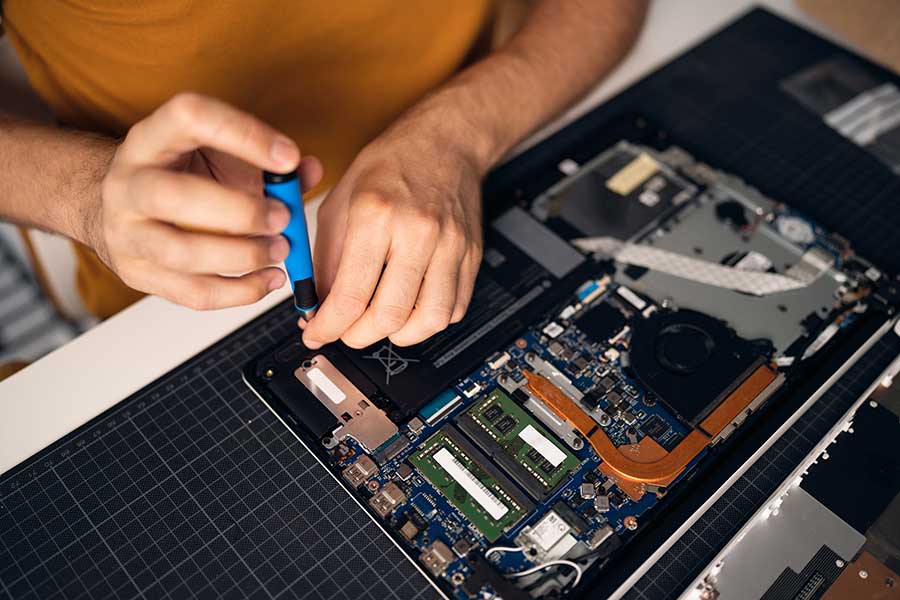
Repairs

Through the Help Desk, certified technicians deliver onsite Dell Warranty repair for your own laptops, computers and other hardware. We can help with: RAM hardware upgrades, operating system upgrades and reinstalls, hardware repair, general PC maintenance and malware and virus removal (not covered under Dell Warranties). You can borrow a temporary laptop and other devices while repairs are underway.

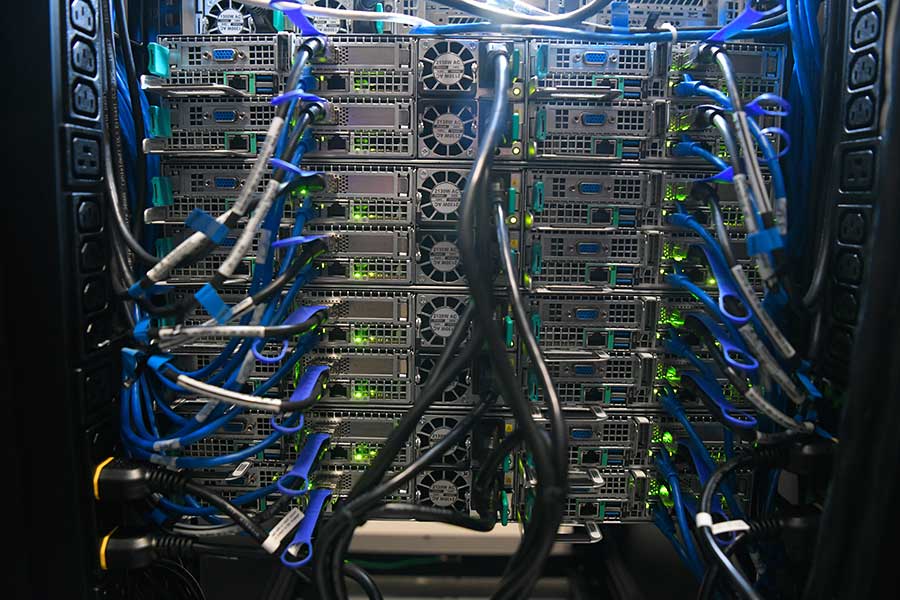
Computer cluster up close

HPC Cluster

Clarkson University owns and operates a High-Performance Computing (HPC) cluster called ACRES (Accelerating Computational Research for Engineering and Science). ACRES's technology allows data- and computationally-intensive research projects to explore complex models and operations at no cost.

An individual teaching another person something on a computer

Teaching and Learning Corner

The Teaching and Learning Corner (TLC) is dedicated to supporting students, faculty and staff in their use of educational technology at Clarkson. We partner with faculty to build satisfying, engaging learning experiences on campus and online. Our online course design methods align with Quality Matters standards, and several have earned QM certification for quality. In addition, multiple awards recognize the TLC team's work in instructional design and faculty development.

The TLC extends employment opportunities to undergraduate and graduate students, who then highlight student perspectives and experiences for our team. In addition, we also assist with student surveys and other research projects.

Online Learning at Clarkson

Make online learning a seamless and engaging experience through Clarkson's wide variety of comprehensive and advanced tools.

Personal Computer and Technology Requirements

Clarkson encourages you to bring a laptop with you to campus. While your specific laptop is a matter of personal preference, we have compiled recommendations for an engaging college experience. Learn more about memory, storage, operating systems and other factors you may want to take into account for both Apple and Windows devices.

Minimum Technology Requirements

FAQs

Wi-Fi access is available in all indoor locations on campus, including residence halls, academic spaces, dining halls, athletic facilities, study spaces and more locations. If you are part of the Clarkson community, we recommend accessing the eduroam wireless network with your login credentials for greater security. If you are a guest, you can access the guest network by selecting the Clarkson University network icon in your wireless settings.

Check your connections first, and then check to see if others are experiencing similar issues. We additionally announce any service interruptions on the OIT webpage. You can subscribe to receive updates by clicking the button located in the upper-right corner.

If you suspect an outage or want to report poor performance, we ask that you contact the Help Desk for further assistance.

You can access hundreds of software programs including: ArcGIS, Matlab, Ansys, Mastercam, AutoCAD, SolidWorks and many other scientific applications popular in engineering, business and other fields. These applications are available both in our computer labs and via the web-based platform called AppsAnywhere.

Safeguarding your security and privacy is one of our top priorities. Clarkson has a robust, standards-based Information Security Program that includes technical controls and administrative policies to maximize the safety of students' personal data. All employees receive annual training on overall information security practices and, more specifically, on protecting the confidentiality of student information.

The main purpose of Clarkson's information technology resources is to support learning, teaching, research and the mission of the University. We expect the use of our tools and services to align with that overarching objective. To learn more about Clarkson's policy on the use of technology, please review section XI.G of Student Regulations.

You can contact the Help Desk on days Monday through Friday by phone, email or walking into our office on the Potsdam campus. Requests received outside of normal business hours are responded to the next business day.