
Artificial Intelligence (AI) and Machine Learning

Artificial Intelligence and Machine Learning at Clarkson are embedded across engineering, mathematics, computing, environmental systems, business, healthcare, and the humanities. Faculty develop new algorithms, design intelligent sensing systems, model environmental hazards, verify software correctness, optimize manufacturing processes, and examine how AI reshapes institutional decision making. 

Faculty across Clarkson contribute to AI research and teaching through interdisciplinary collaboration, applied projects, and student mentorship. Students encounter AI as a working methodology, participating in research groups, developing applied models, and integrating machine learning into disciplinary problem solving.

Across Clarkson

AI/ML at Clarkson functions both as a technical discipline and as a cross-disciplinary analytical tool. Faculty and students contribute to:

  • Physics-informed and scientific machine learning
  • Intelligent manufacturing and sensing systems
  • Infrastructure and environmental risk modeling
  • Formal reasoning and algorithm verification
  • AI governance and institutional systems
  • Health and AI applications
  • Strategic and organizational decision-making

Rather than concentrating AI/ML within a single program, Clarkson builds distributed expertise across departments, allowing students to combine machine learning with domain knowledge in engineering, science, business, and the other disciplines.

AI/ML Research at Clarkson

Clarkson research in Artificial Intelligence and Machine Learning spans theoretical foundations, experimental sensing systems, industrial applications, and institutional analytics. Faculty and graduate researchers collaborate across departments, with student projects often emerging directly from these research environments. Learn more about our areas of research below by expanding each accordion. 
Clarkson researchers integrate machine learning with sensing technologies, additive manufacturing, ultrasonic evaluation systems, and industrial process modeling. Work in this area combines experimental data, simulation, and physics-informed learning to enable quality monitoring, defect detection, and predictive manufacturing analytics.

Recent research and student projects include physics-informed machine learning for granular materials, additive manufacturing monitoring, and neural-network modeling of fracture particle dispersion.

Faculty & staff working in this area

  • Çetin Çetinkaya
    Applies machine learning and sensing technologies to manufacturing quality assurance, additive manufacturing monitoring, and engineering education.
  • Goodarz Ahmadi
    Develops neural-network models informed by CFD–DEM simulations to predict particle behavior in hydraulic fracturing systems.
  • Leo Jiang
    Applies neural network models and advanced analytics to power grid optimization and hydropower forecasting.
  • Jacob Weller
    Implements AI-enabled manufacturing tools and intelligent machining support systems within engineering shop environments.

Faculty apply AI to landslide susceptibility modeling, climate-integrated terrain analysis, and intelligent sensing platforms for environmental and public health monitoring. These projects emphasize interpretability, uncertainty estimation, and real-world decision support.

Faculty working in this area

  • Suguang Xiao
    Develops interpretable machine learning models for landslide susceptibility and geotechnical hazard assessment using terrain and climate data.
  • Silvana Andreescu
    Integrates machine learning with biosensing platforms to advance environmental monitoring, biomarker detection, and smart diagnostic systems.

Clarkson researchers contribute to physics-informed neural networks, PDE-integrated learning frameworks, causal discovery, and nonlinear signal localization. This work embeds governing physical laws into neural network training, improving stability, interpretability, and efficiency in scientific modeling.

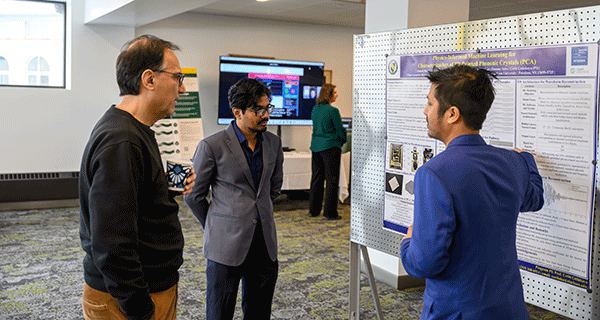
Some of our faculty’s work further highlights student and faculty collaboration in physics-informed ML, nonlinear signal localization, and kernel-enhanced neural modeling of material evolution.

Faculty working in this area

  • Guangming Yao
    Develops physics-informed neural networks and data-assisted PDE solvers for materials science modeling and quantitative finance applications.
  • Kevin Slote
    Develops causal discovery methods and maintains the open-source CausationEntropy library for inferring causal networks from time-series data.
  • Mahesh Banavar
    Applies machine learning and signal processing to nonlinear sensing, biomedical signal analysis, and data-driven modeling of complex physical environments. His research develops AI methods for physiological monitoring, signal localization, and intelligent sensing applications through collaborative student research.
  • Tyler Conlon
    Works in embedded and edge AI systems, including TinyML research and hardware-constrained machine learning.

Clarkson maintains expertise in logic-based AI systems designed to perform formal deduction and verify correctness in software and cryptographic systems. This work complements statistical machine learning by addressing reliability, correctness, and trust in computational systems.

Faculty working in this area

  • Christopher Lynch
    Designs automated reasoning algorithms for formal verification of software and cryptographic systems.

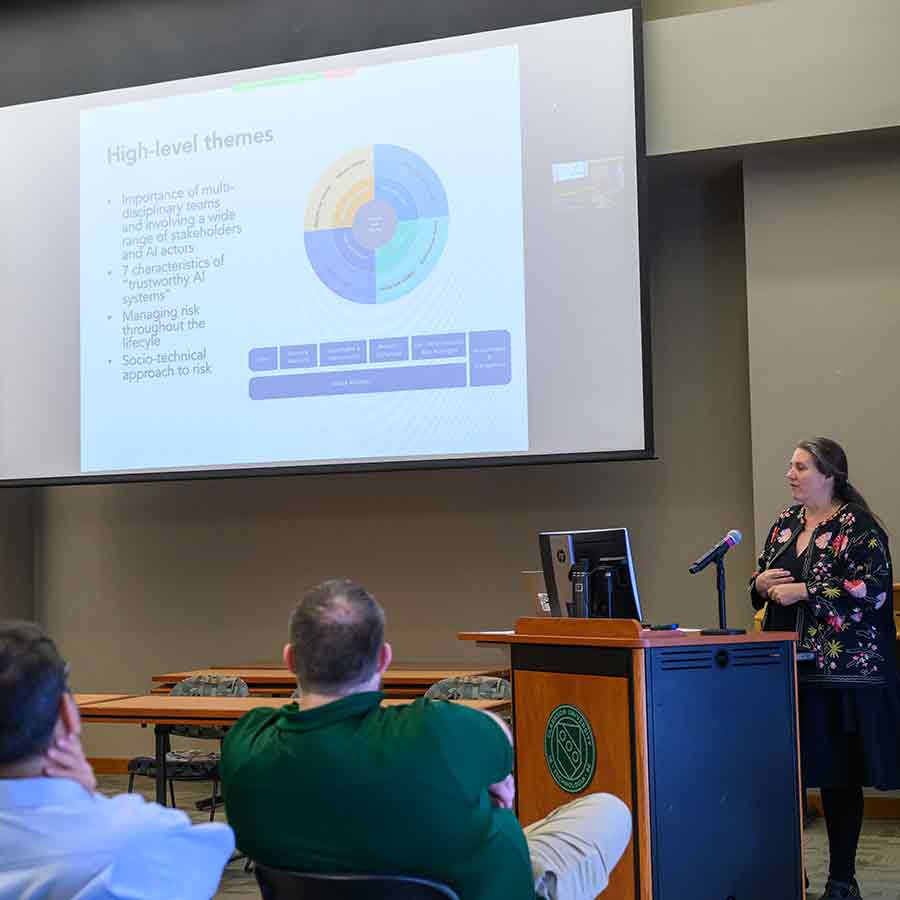
Faculty examine AI risk management, adversarial testing, algorithmic accountability, social communication analysis, and machine learning applications in healthcare and organizational systems. Research explores how AI influences professional judgment, decision-making structures, and institutional oversight.

Faculty and student projects include work in mental health detection, emergency medical response analytics, and AI-assisted social support illustrate applied institutional AI research involving both faculty and students.

Faculty working in this area

  • Jeanna Matthews
    Researches AI risk management, adversarial testing, and algorithmic accountability across security, virtualization, and societal decision-making systems.
  • Stephen Casper
    Examines AI as a sociotechnical system, focusing on institutional impact, governance, and professional authority.
  • Lisa Legault
    Uses LLM-assisted coding and thematic analysis to study motivational messaging and social change communication on social media.
  • Christian Felzensztein
    Studies ethical AI governance and sustainable innovation strategies for startups and small organizations.
  • Sumona Mondal 
    Studies AI applications in mental health detection and multimodal behavioral signal analysis.

Artificial Intelligence and Machine Learning are integrated directly into coursework across Clarkson. Students train and evaluate models, apply deep learning to satellite imagery and LiDAR datasets, use AI-assisted writing tools grounded in research, and engage with AI-based engineering tutors and workforce simulations.

Our faculty work in projects further demonstrate classroom to research pathways, including TinyML microcredential development, embedded AI education, and project-based learning in edge AI systems.

Faculty integrating AI into teaching

  • Matthew Manierre
    Studies the use of AI-assisted writing revision in first-year seminars and evaluates how AI tools influence student writing development and confidence.
  • Jess Leja
    Developed faculty-facing AI resource infrastructure supporting responsible generative AI use in teaching and academic workflows.
  • John Milne
    Develops AI-informed course design and innovation reporting frameworks supporting invention-focused learning and curriculum development.
  • Rachel Dellis
    Designs AI-supported instructional simulations, including interactive PLC training environments for workforce development and technical education.
  • Çetin Çetinkaya
    Applies machine learning and sensing technologies to manufacturing quality assurance, additive manufacturing monitoring, and engineering education.
  • Anna Brown
    Integrates AI tools into tax research coursework to support student analysis of evolving tax policy and regulatory frameworks.
  • William Olsen
    Teaches deep learning methods for extracting geospatial information from satellite imagery, UAV data, and LiDAR point clouds.
  • Pat Wilbur
    Develops AI teaching assistants, automated study guide generation tools, and interactive AI learning avatars.
  • Stacey Zeigler
    Explores AI as a decision-support partner in leadership and healthcare management education.

Student Pathways

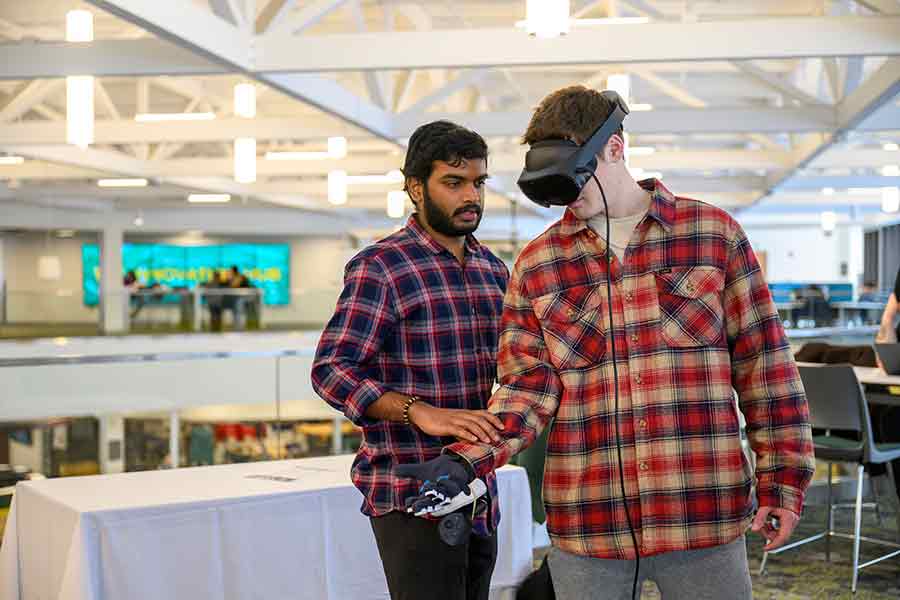
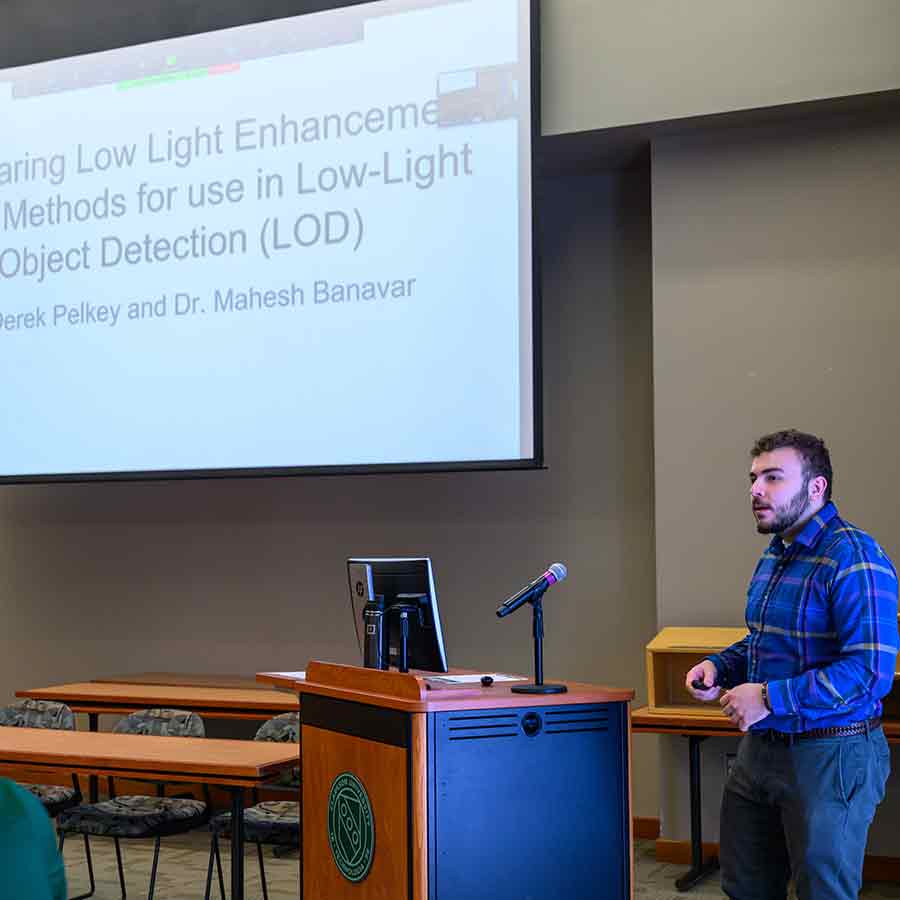
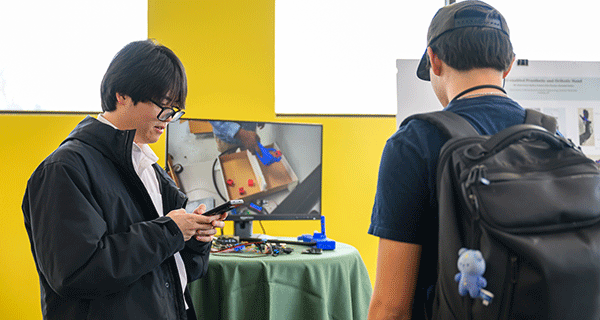
Students engage with AI at Clarkson through faculty led research, graduate thesis projects, interdisciplinary honors work, and course integrated modeling applications. Recent student work includes biometric authentication systems, nonlinear signal localization frameworks, emergency response analytics, low-light object detection, generative physiological signal modeling, and computational biology classification models.
These projects demonstrate how students move from coursework into applied research environments. Many of these projects are conducted in collaboration with faculty research groups, allowing students to participate directly in ongoing AI research.