Research Topics
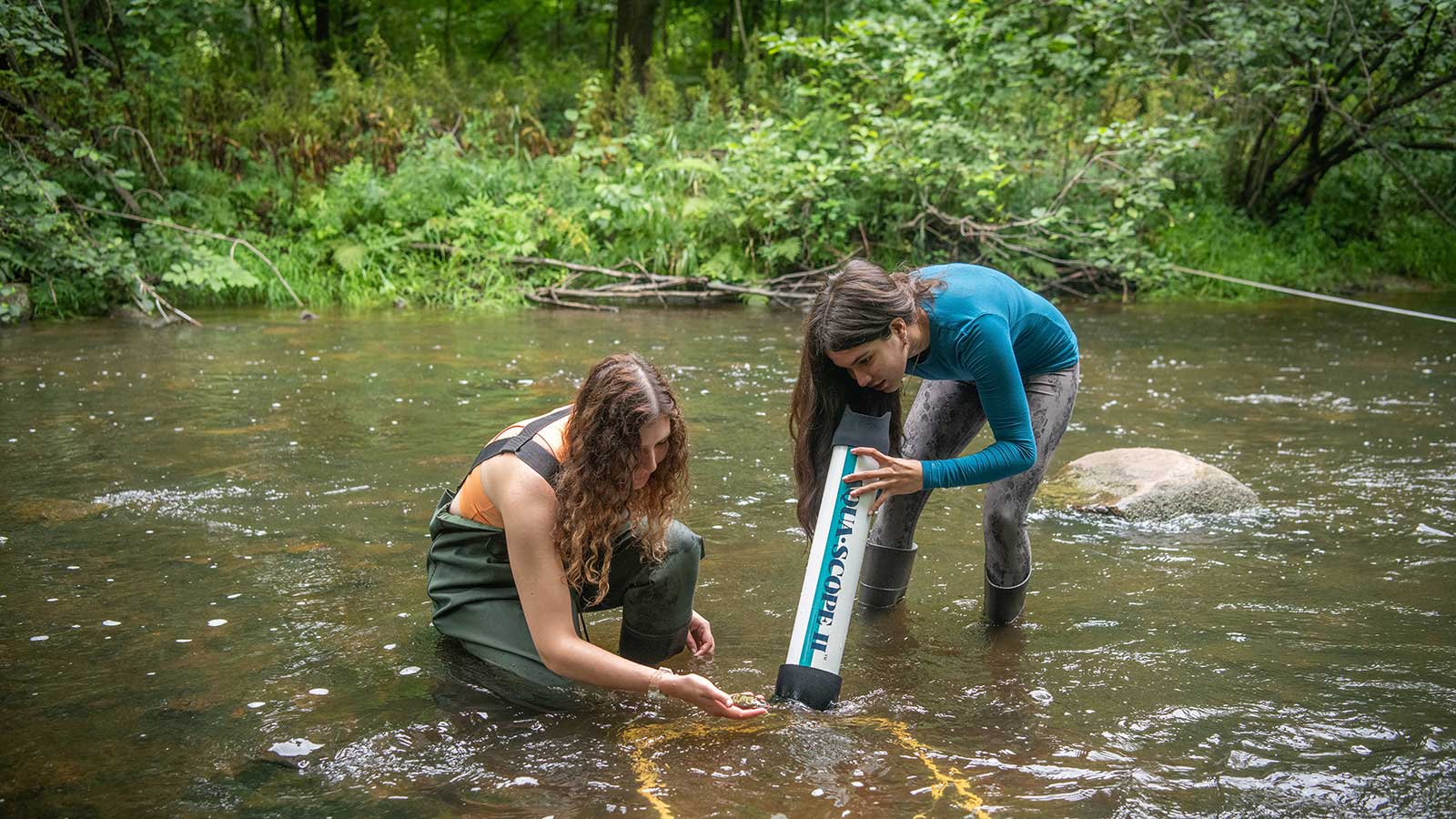
The ASET-REU program leverages the location of Clarkson’s New York State campuses (in Potsdam, Beacon, and the Capital District) in and along two of the United States’ most iconic, and environmentally and historically rich aquatic basins—the Great Lakes-St. Lawrence River.
The following projects fit within the Great Lakes-St. Lawrence River ASET REU theme, are organized into three foci of Aquatic Natural Sciences; Aquatic Social, Behavioral and Economic Sciences; and Aquatic Resource Engineering, and are available to participate in for the upcoming summer.
Aquatic Natural Sciences Projects
The King Lab employs interdisciplinary methods, from inorganic and physical chemistry as well as materials science, towards the development of photoactive nanomaterials. We are employing surface-enhanced Raman spectroscopy of ground water contaminants using plasmonically active gold nanoparticles for the detection of PFAS type molecules at parts per billion.
Dr. Holsen's lab develops and evaluates technologies for the treatment of per- and polyfluoroalkyl substances (PFAS) in water and wastewater. Decades of industrial and consumer use have left PFAS widely present in drinking water sources, groundwater, and landfill leachate, and these compounds are notoriously resistant to conventional treatment because of their strong carbon-fluorine bonds. Today there is an urgent need for treatment approaches that fully destroy PFAS rather than simply concentrating or transferring it between media, as many current methods do. REU students will work with graduate students to design, build, and operate bench-scale treatment systems, and to use novel analytical techniques to evaluate treatment performance, reaction mechanisms, and byproduct formation across different PFAS compounds and water matrices. Results obtained will: 1) advance scalable treatment technologies for PFAS-contaminated water and wastewater, 2) elucidate the mechanisms and byproducts involved in emerging PFAS destruction processes, and 3) provide data for regulators and treatment facilities evaluating next-generation PFAS remediation options.
Dr. Andreescu’s research interests are in the areas of bioanalytical chemistry, electrochemistry, biosensing and environmental nanotechnology. Increased industrial and agricultural activity has affected the water circuit, with implications on the normal functioning of natural ecosystems and the availability of clean water sources for human consumption. Phosphorus (P) and nitrogen (N) export from agroecosystems has become a major issue with the increased rates and intensity of harmful algae blooms (HABs) and eutrophication acceleration, which kill fish, pollute drinking water, and alter tourism. The challenge of managing and preventing eutrophication is therefore two-fold: (1) the lack of effectively field monitoring tools that can identify areas of high P and N pollution and (2) the lack of engineering tools and methods to decrease environmental impact. Andreescu’s overall research project goal is to develop an easy-to-use inexpensive sensor that can selectively measure P in eutrophic waters. To achieve this goal, REU students will engineer materials possessing P-binding sites and graft them on high surface area sorbents with built in recognition and transduction capabilities. Students will test the hypothesis that these materials will respond and sense P by changing their properties upon binding, and that this mechanism can be used to create inexpensive sensors for monitoring essential nutrients in aquatic environments. Outcomes of this research will be a new technology solution to measure nutrients in contaminated nutrient-rich water sources with increased portability, low cost and the potential for large-scale deployment. This experience will provide REU students with the opportunity to acquire knowledge in materials synthesis and characterization as well as analytical skills, while developing novel technological solutions to current and emerging challenges in the environmental monitoring field.
Dr. Bailey’s research group explores how spatial structure and environmental complexity alter the evolution of microbial species and communities. Natural aquatic systems vary tremendously across both large and small spatial scales, from highly-structured riverbed substrates to well-mixed water columns, with nutrients rarely distributed evenly. The physical structure of an environment dictates whether bacteria and their nutrient resources remain localized in discrete patches or become homogenized by active movement, passive diffusion, or fluid mixing. This project explores how nutrient patchiness influences evolutionary trajectories when bacteria adapt to structured versus well-mixed environments. The REU student will help maintain and analyze laboratory evolution experiments comparing bacterial adaptation under uniform versus patchy resource conditions. Through this work, the student will measure evolved changes in population growth rates, spatial colony expansion, and potential trade-offs between dispersal and local resource exploitation. The participant will gain hands-on experience in experimental evolution, microbial culturing techniques, spatial data processing, and statistical analysis.
Dr. Langen's project focuses the population dynamics of mosquito species that serve as vectors of West Nile Virus, Eastern Equine Encephalitis Virus, Cache Valley Virus, and other pathogens. The population ecology and dynamics of many mosquito species are poorly known, making it difficult to predict and control disease outbreaks. Working with St. Lawrence County Public Health and students at both Clarkson University and SUNY Potsdam, students on this project will learn how to collect and classify to species the nearly 30 mosquito species in our region, collecting at four field sites adjacent swamps and vernal pools, and will send these to New York’s public health lab for viral screening. Students will analyze the patterns over the least three years of data collection, and data from state-wide mosquito surveys and viral screening.
Dr. Imtiaz and his AI Vision Lab are developing an AI-vision-enabled monitoring system to automatically detect and track fish movement through an experimental open-channel flume. Currently, three GoPro cameras are mounted above the flume to capture fish movement, and researchers analyze the recorded videos manually. The proposed system will improve the efficiency and reliability of fish monitoring by replacing manual analysis with an automated computer-vision-based approach. The revised system will utilize two top-mounted high-resolution cameras, if feasible, to provide continuous coverage of the observation zone and capture the complete fish pathway. Attention will be given to achieving spatial and temporal continuity between the two camera views so that fish trajectories can be reconstructed across the entire observation area. The captured video data will be processed using deep-learning-based object detection and tracking models, such as YOLO and associated tracking algorithms. The system will automatically identify individual fish and quantify their movement path, location, velocity, acceleration, and passage time through the observation zone. REU students will support the development, testing, and optimization of the vision system under different flow and lighting conditions and evaluate its performance against existing manual video-analysis methods.
Aquatic Resource Engineering Projects
Dr. Baki’s ecohydraulics research lab was built to enhance our understanding of the ecohydraulics for healthy water solutions. During the summer 2027, Dr. Baki will run the following research projects: Live Fish Experiments: This experimental study systematically examines the influence of hydrodynamics resulting from instream boulders placement on live fish behaviors (e.g., resting time, swimming performance and cost, passages efficiency, social facilitation, etc.). To observe fish dynamics, two underwater cameras and three top-view cameras will be used, and an artificial intelligence (AI) deep learning algorithm will be developed and employed to track fish positions over time. The outcomes of this study could inform effective river restoration projects and guide future research efforts to understand fish behaviors and social dynamics within riverine fish populations, emphasizing the importance of considering hydrodynamics. Microplastics Pollution and their Dynamics: This study analyzes water samples from a water treatment plant to evaluate the current efficiency of microplastics removal and recommend advanced technologies or techniques for more effective microplastics filtration. Additionally, experimental and numerical approaches characterizes the dynamic behavior of microplastics in water bodies, providing accurate models for predicting their settling, transport, and retention rates. The outcomes will contribute to improving water treatment processes and enhancing our understanding of microplastics dynamics in aquatic environments.”
Dr. Podlaha-Murphy's REU project seeks to remove contaminants from industrial waste streams. In particular, dyes, nitrates, and azoles from wastewater using innovative electrolysis processes are of interest. A barrier to the wide adoption of electrolysis is the high energy needs for electrochemical reduction; hence better electrocatalysts and separation strategies are needed with long lasting stability. Materials that are useful electrodes that aid in adsorption of these pollutants often not very reactive and vice versa. This project’s goal is to develop novel composite materials for a variety of different pollutant. Textile, paints, pulp and paper, carpet and printing industries are well known to generate large volumes of wastewater containing synthetic dyes that have carcinogenic effects on human bodies. Dye effluents can obstruct light penetration in the water of lakes, rivers etc. thus inhibiting the biological processes based on photosynthesis. A number of chemical industries generate nitrate and nitrite waste that if consumed can cause numerous health effects, including cancer in adults, as well as methemoglobinemia or “blue baby syndrome” in children. Azoles are common corrosion inhibitors in semiconductor processes and has high toxicity to plants, invertebrates, and microorganisms. The REU student can choose one of these three pollutant areas. The organic pollutants will be oxidized using an electrochemically assisted Fenton reaction with titania-based metal alloy composites and the inorganic nitrates will be reduced with graphene-based metal alloy composites made from abundant, inexpensive elements. The project will include fabrication of the composite by electrodeposition, materials characterization (e.g., inspection of morphology by scanning electron microscopy, and determination of deposit composition including x-ray fluorescence) and testing of the degradation of the pollutants. No experience in electrochemistry is required.
Dr. Yang’s group integrates chemical engineering, environmental chemistry, and material science principles to address critical challenges in renewable energy production, water treatment, and water reclamation. Ongoing projects in his group to enhance water security include the development of: 1) an electrochemical oxidation process for the treatment of per- and polyfluoroalkyl substances in landfill leachate; 2) a fast electrochemical disinfection process for the inactivation of pathogens and the control of antibiotic-resistant gene; 3) an electrochemical method for the control of harmful algae bloom in aquatic systems. REU students will learn the principles of redox chemistry, electrochemistry, and advanced oxidation/reduction processes. Students also will receive immersive experience on 1) the design and operation of the electrochemical reactor and 2) the analysis of the transformation of target pollutants during electrochemical treatment. In addition to lab-based studies, students will have hands-on experience in operating the full-scale (500 m3/d) boat-mount electrochemical algae treatment prototype in Great Lakes-St. Lawrence watersheds. Also, we are expecting to have field tests every summer to evaluate the performance of a full-size HAB terminator product in a New York State lake. The REU project could be integrated into this research task.”
Dr. Kim’s lab develops innovative electrochemical technologies to remove and recover ammonium from wastewater, addressing its harmful effects on aquatic systems while conserving its value as a fertilizer. Because ammonium concentrations vary significantly depending on the wastewater source, different electrochemical separation strategies are required. Students will study the landscape of wastewater generation and treatment, gaining hands-on experience operating several electrochemical systems designed for various wastewater streams. For low ammonium concentrations in sewage, selective membranes or electrodes are required for effective separation. To handle high ammonium concentrations in landfill leachate and anaerobic digestate liquid, the solution pH is elevated via electrochemical reactions to convert ammonium into volatile ammonia, which is then recovered through air or membrane stripping. Energy consumption is quantified alongside resource recovery efficiency to evaluate both technical and environmental benefits. Overall, Dr. Kim’s lab provides undergraduate students with valuable research experience at the intersection of water, energy, and food, using electrochemistry as a foundational core.
River Geomorphology: River geomorphology describes how rivers change shape over time due to natural disturbances and human activities. The student participating in this REU project will investigate the channel geometry, such as width, depth, slope and planform of rivers and streams by using data published in literature and/or collected through remote sensing.”