Image
In today's digital age, electricity keeps the world running. Electrical engineers design everything from the nation’s power grid to the microchips inside our cellphones. Graduates of Clarkson University's Bachelor of Science in Electrical Engineering program can find work in virtually every industry. You'll find competitive salaries, the chance to work in a variety of sectors and the opportunity to be at the forefront of today's innovations.
Clarkson's low student-to-faculty ratio allows our professors to get to know you as an individual while you engage together in research. This unique relationship between faculty and students is the hallmark of the Clarkson educational experience.
The electrical engineering program's team-based, collaborative approach encourages you to apply your knowledge and skills to solve practical, real-world problems. These skills, combined with Clarkson's in-depth curriculum, provide you with a strong foundation for a successful career.
Beyond the classroom, you can choose to get involved in research, study abroad, take on extracurricular projects or participate in professional development activities.
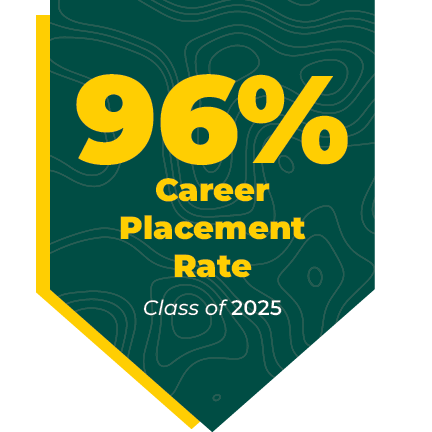
And, our 2025 graduates from the Electrical Engineering program had a 100 percent placement rate.
Clarkson’s Electrical Engineering program prepares you to design, build and optimize the technologies that power and connect our world, combining strong foundations in circuits, electronics and systems with hands-on experience in areas like power systems, signal processing, robotics and control systems. Through labs, undergraduate research opportunities and a culminating capstone experience, you’ll apply what you learn to real-world engineering challenges while working closely with faculty mentors. As emerging technologies like artificial intelligence and machine learning continue to transform how we manage energy grids, automate robotics and process complex signals, Clarkson students gain exposure to these rapidly evolving fields through coursework, research opportunities and the Artificial Intelligence & Machine Learning minor. You’ll graduate ready to innovate in a changing technological landscape while bringing the critical thinking, creativity and engineering judgment that technology alone cannot replace.
Learn more about how Clarkson is at the forefront of AI & Machine Learning
From the start, you'll be immersed in real-world problems, learning from expert faculty in both classroom and lab experiences using sophisticated equipment that meets or exceeds industry standards.
You'll take such courses as:
For more information, view the course catalog for current program requirements, course numbers and credit hours
The electrical engineering program consists of 36 credit hours in electrical engineering and 27 credit hours of first year engineering curriculum. 6 credit hours are in free electives.
All courses are 3 credits unless noted.
The following courses are required for all students, irrespective of their program of study. These courses are offered during the fall semester, with FY100 First-Year Seminar being required of only first-year students. Both FY100 and UNIV190 are typically taken during the fall semester of the first year at Clarkson.
FY100 First-Year Seminar (1 credit)
UNIV190 The Clarkson Seminar (3 credits)
Students are required to complete the following courses:
Electrical Engineering
Professional Experience
Students are required to complete the following Professional Experience:
ES499 Professional Experience (0 credits)
Students must complete the following courses in their first year:
Students must complete the following courses:
Mathematics/Electrical Science
Area Electives
Students must take 5 EE courses 300-level or above. BR400 can substitute an EE course.
Additional Electives
Students are also required to take one Math Elective outside of the Core Requirements, as well as one Electrical Science Elective and one Electrical Science or Science Elective.
Knowledge Area/University Course Electives
Students will have at least 15 credit hours available to use toward Knowledge Area and/or University Course electives to satisfy the Clarkson Common Experience requirements.
Free Electives
Students will have approximately 6 credit hours available to use toward courses of their choice.
Our engineering professors are also active researchers. Working on high-impact projects such as clean energy grid integration, autonomous signal processing, and advanced semiconductor technologies. Enriching opportunities are available to all engineering undergraduate majors, including projects sponsored by agencies like the National Science Foundation and the New York State Energy Research and Development Authority, as well as by private companies. In addition, students engage in research to complete their senior capstone design projects and to gain professional, hands-on experience.
As an electrical engineering major, you'll have access to internships and co-op opportunities with top employers across energy, defense, semiconductor, and technology sectors. Our students gain experience at leading organizations such as National Grid, IBM, Lockheed Martin, GlobalFoundries, BAE Systems, and General Motors. Twice a year, nearly 200 employers come to campus to recruit undergraduate Clarkson students for these experiences, including many looking specifically for electrical engineers.
Electrical engineering students can get involved outside the classroom through over 200 clubs and organizations on campus, including several related to electrical engineering. These include:
A minor in electrical engineering is available to students in any degree program. An electrical engineering program minor provides you with a foundation in learning energy systems, basic electrical science and digital design. Why choose to minor in electrical engineering? It is and will continue to be key to a future that balances energy resources and production with human quality of life. Many engineering students can complete the minor in four years.
All courses are 3 credits unless noted.
Electrical Engineering Minor Core Requirements
Students are required to complete the following courses:
ES250 Electrical Science
EE264 Introduction to Digital Design
EE331 Energy Conversion
EE381 Electromagnetic Fields and Waves
Electrical Engineering Minor Core Electives
Students must complete two of the following courses:
EE221 Linear Circuits
EE321 Systems and Signal Processing
EE324 (ME324) Dynamical Systems
EE333 Power System Engineering
EE341 Microelectronic Circuits
A Software Engineering minor provides a strong foundation in the design, development and maintenance of software systems. You’ll gain experience in programming, software architecture, testing and collaborative development practices, preparing you to create reliable, efficient and scalable solutions. Learn more about the Software Engineering minor.
A minor in Physics deepens your understanding of the fundamental principles that govern the natural world. Through coursework in mechanics, electricity and magnetism, and modern physics, you’ll strengthen your analytical and problem-solving skills while gaining insight into the concepts that drive scientific and technological innovation. Learn more about the Physics minor.
A minor in computer science gives you a strong foundation in programming, basic software engineering principles and the design, analysis and implementation of data structures and algorithms Learn more about the Computer Science minor
This multidisciplinary field weds mechanical engineering, electrical engineering, software engineering and computer science. In this minor, see how robots are taking on jobs too dirty, dangerous or dull for humans. Learn more about the Robotics minor.
A Mathematics minor develops strong analytical and quantitative problem-solving skills through coursework in calculus, differential equations, linear algebra, mathematical modeling and data science. You’ll learn to apply mathematical methods to real-world challenges, building a foundation that supports innovation, critical thinking and data-driven decision-making across a wide range of fields. Learn more about the Mathematics minor.
As artificial intelligence and machine learning become increasingly important across industries, graduates with expertise in intelligent systems, data analysis, and AI-driven technologies will be in high demand. The Artificial Intelligence and Machine Learning Minor provides students with the knowledge and skills needed to develop innovative solutions to complex challenges. Learn more about the AI and Machine Learning minor.
Become a Solinsky Engineer.
The Solinsky Engineers Program is designed to give future engineers a community, a $20,000 scholarship to attend Clarkson for four years, and a variety of incredible benefits to enhance their educational and co-curricular college experience.
Being a Solinsky Engineer opens doors to real experience, camaraderie, and accelerated career growth. We'll choose up to 100 first-year engineering majors annually to be a part of this exciting initiative. Find out how to apply.
Growth for electrical engineers is predicted to be steady over the next decade. Opportunities exist in all sectors of the economy, such as:
Class of 2025 graduates in Electrical Engineering started their careers with an average salary of more than $76K. For those entering the workforce, common job titles include:
Almost all organizations require some form of electrical engineering to support their operations.
Our electrical engineering majors have gone on to work at companies such as:
Clarkson’s electrical engineering students and faculty are making meaningful contributions to research and innovation. From presenting work at professional conferences to developing new technologies, these achievements showcase the creativity, dedication, and real-world impact of the Clarkson engineering community.
Clarkson junior Matthew Whispell has had his paper, “Benchtop to Field: Hardware Optimization and Validation of a Low-Power Wireless Potentiostat,” accepted for presentation at IEEE UEMCON 2026. The work focuses on optimizing and validating universal portable electrochemical sensing. The research was jointly supervised by Clarkson Professors Masudul Imtiaz and Silvana Andreescu and was supported by Clarkson’s NSF REU program.
Recent Clarkson Ph.D. graduate Naveen has received an Honorable Mention at the IEEE/IAPR International Joint Conference on Biometrics (IJCB) 2026 in Rome for the paper “What Drives Bilateral Iris Encoding in Deep Learning?” The work, conducted with Professors Masudul Imtiaz and Stephanie Schuckers, investigates what deep iris-recognition models learn when encoding left and right irises and explores why bilateral structure matters in how these models represent identity. The recognition highlights Clarkson's research in biometrics, deep learning, and the development of more explainable approaches to iris recognition.
Clarkson graduate student Art Nugyan’s paper, “Design of a High-Resolution Infant Fingerprint Scanner Using a Low-Cost COTS Camera,” has been accepted for presentation at IEEE UEMCON 2026. The work focuses on developing a novel infant biometric capture system to make pediatric biometric capture more accessible and practical. The research was supervised by Clarkson Professors Masudul Imtiaz and Stephanie Schuckers and supported by CITeR and the NSF ERI program.
As an electrical engineering major, women at Clarkson have countless opportunities, from professional experiences to studying abroad and more.
Women at Clarkson have opportunities to build connections with fellow students, learn from faculty mentors, and gain hands-on experience through engineering projects. By collaborating with peers and exploring their interests, students can develop the technical skills, confidence, and professional relationships that support their success in engineering.
From the classroom to professional experiences, Clarkson encourages women to pursue their goals, challenge themselves, and discover the many paths available in electrical engineering. These experiences help prepare students to become the next generation of engineers, innovators, and leaders.
The Bachelor of Science program in Electrical Engineering is accredited by the Engineering Accreditation Commission of ABET, under the commission’s General Criteria and Program Criteria for Electrical, Computer, Communications, Telecommunication(s), and Similarly Named Engineering Programs. Read more on Engineering Program Objectives.
An electrical engineering degree from Clarkson gives you the skills and the confidence you need to succeed in an in-demand career. Find out more today.