Clarkson Connects Semiconductor Leaders to Tackle Next-Generation Chip Challenges
As computer chips become smaller, more powerful and more complex, the scientists and engineers responsible for manufacturing them face an increasingly difficult challenge: developing processes precise enough to keep pace.
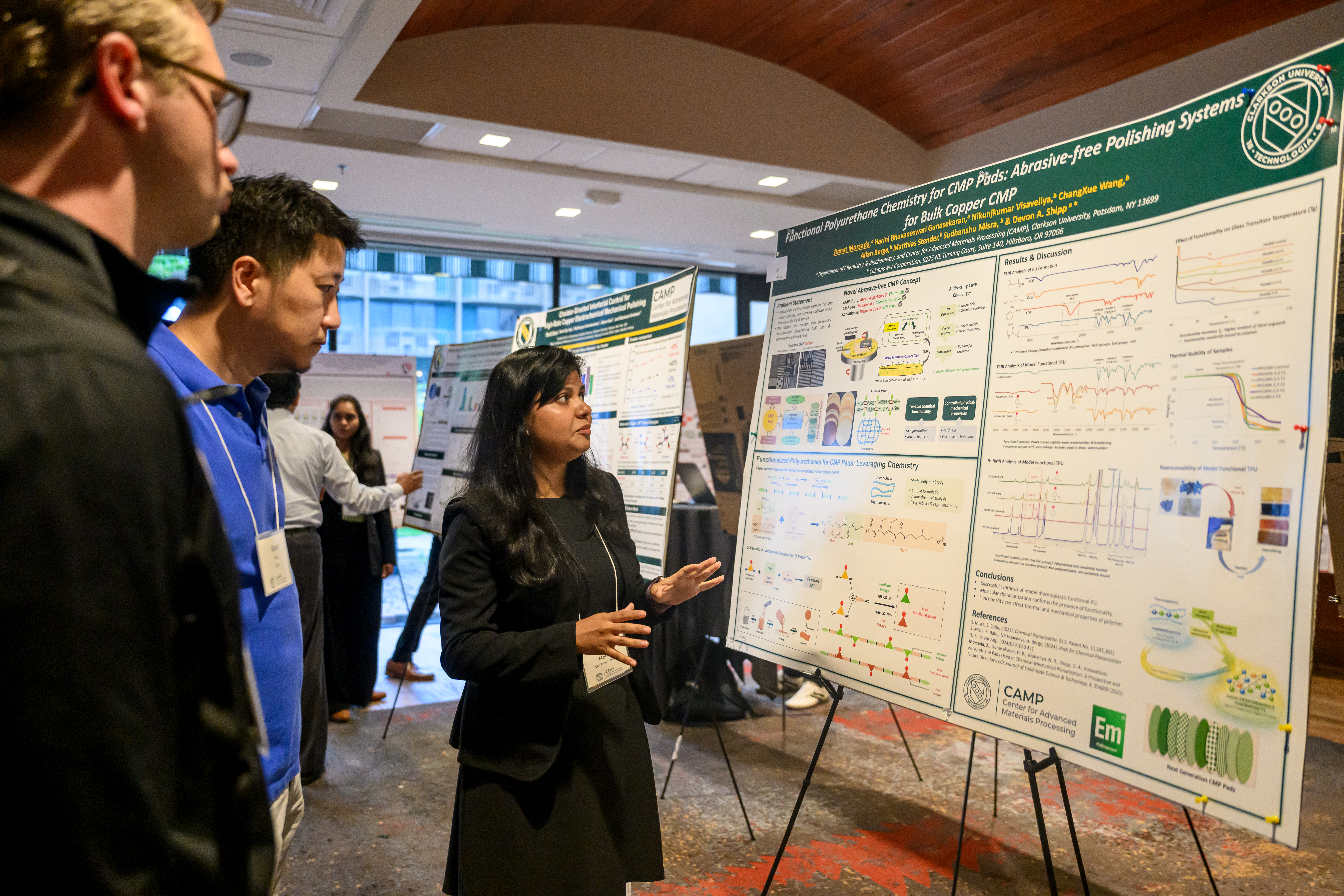
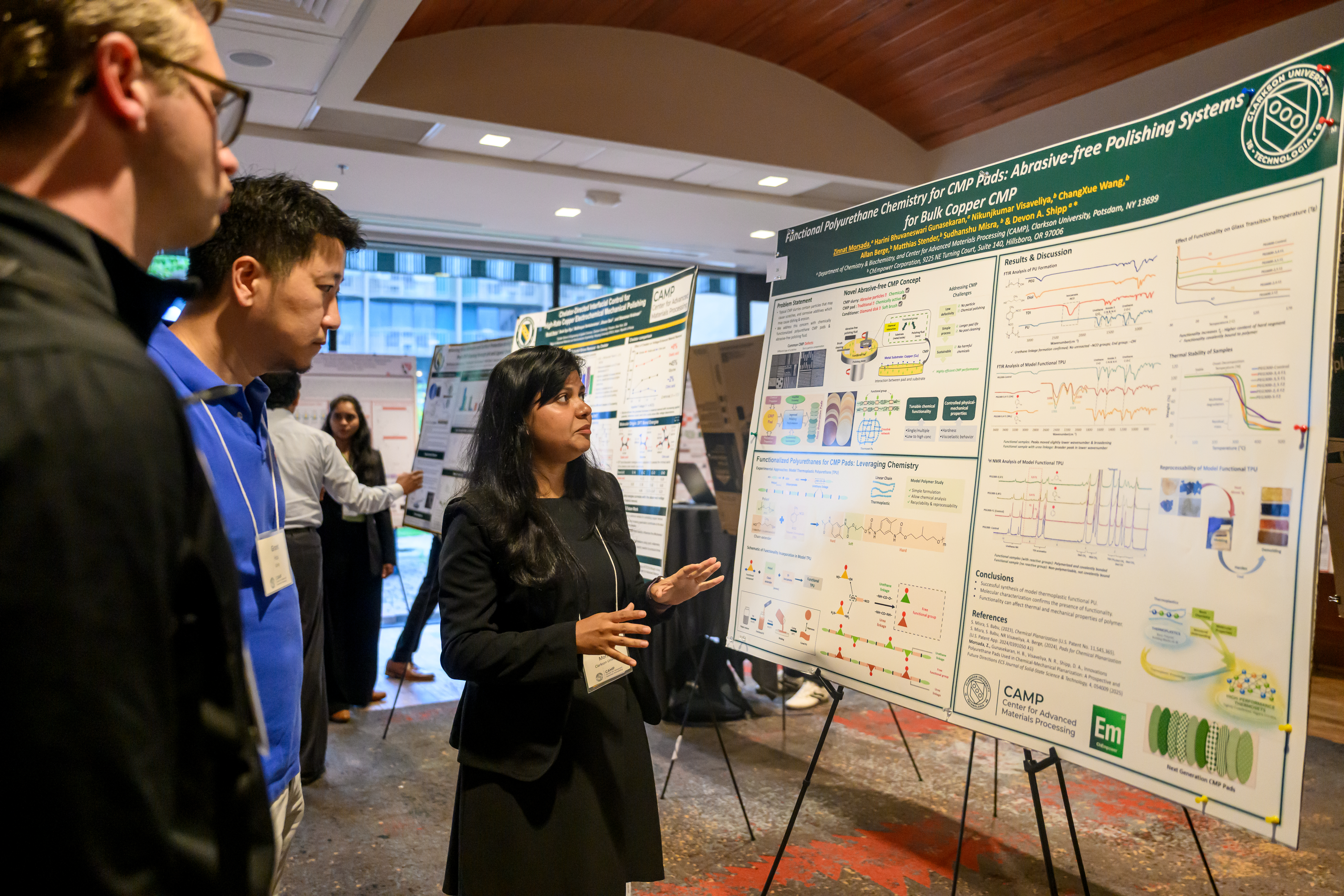
The experts working at the forefront of that challenge gathered in Lake Placid, New York, Aug. 2-5 for the International Symposium on Chemical-Mechanical Planarization (CMP), hosted by Clarkson University’s Center for Advanced Materials Processing (CAMP).
The symposium brought together researchers and representatives from major semiconductor manufacturers, suppliers and universities around the world to exchange ideas about CMP, a critical process used to polish and clean the layers of material that make up computer chips.
For Jason Keleher ’98, ’04, who has spent much of his career working in CMP, Clarkson has created a gathering unlike any other in the field.
“This conference is the best conference for what we do,” Keleher said. “I think it really is the premier conference in the industry.”
Keleher worked in industry at Komag Inc. and Cabot Microelectronics and is now chair of chemistry at Lewis University. He said CAMP has built an environment where researchers can challenge conventional approaches while bringing students directly into the innovation process.
“CAMP has always been at the forefront of making what we want to do differently a reality,” Keleher said. “But moreover I think they are doing it with students and the students are getting actively involved in this space.”
That combination of academic research and industry expertise is increasingly important as semiconductor manufacturers contend with rapidly changing technologies.
Each new material or change in chip architecture can create new challenges for CMP. At the same time, the industry is looking for ways to manufacture both advanced and more traditional chips more efficiently, affordably and sustainably.
The value of Clarkson’s symposium is not only in the research being presented, but also in bringing different parts of the semiconductor industry into the same room.
Elizabeth Di Geronimo, a senior research engineer in material science with Saint-Gobain Research North America, said those interactions can help bridge gaps that exist between companies throughout the semiconductor supply chain.
“We have this gap between us and the foundries. Being here allows us to have a connection between myself, the supplier and the foundry, who is the final consumer,” Di Geronimo said. “It is in this space where you manage to have all these interactions at once and the discussions are valuable.”
Those conversations help researchers and suppliers better understand the problems manufacturers are facing and identify what products and technologies may be needed next.
Clarkson’s role in facilitating those discussions is rooted in the University’s expertise in surface science, engineering, chemistry and colloid science. CAMP Director Devon Shipp said Clarkson researchers became involved in CMP because they had the fundamental scientific expertise needed to understand a complicated manufacturing process.
“Clarkson was approached by IBM not long after they first developed the CMP process as they wanted to know more about the underlying science and engineering of CMP. We had several faculty who jumped right in because they had this fundamental technical background that could help out the CMP industry,” Shipp said. “That initial core group of faculty grew quickly as other faculty at Clarkson with complimentary expertise were brought in. This helped immensely since the processes in CMP are grounded in so many disciplines, such as chemistry and physics, as well as engineering fields such as mechanical and chemical engineering.”
Today, the challenges facing that community continue to evolve.
“What’s happening in the semiconductor industry is that the types of computer chips that are needed to power the world are getting more complicated,” Shipp said.
Advanced chips used for artificial intelligence and high-performance computing require increasingly complicated architectures and materials. Meanwhile, simpler chips remain essential to countless everyday technologies and must be manufactured more efficiently and at lower cost.
Sustainability has also become a major focus. CMP can require significant amounts of water, while researchers are also exploring alternatives to chemicals traditionally used in the process. Artificial intelligence could help researchers accelerate the development and optimization of new CMP processes.
But the industry also needs people.
“This conference really is where we develop the next generation minds that need to be in this field,” Keleher said.
Clarkson materials science and engineering Ph.D. student Murali Ramu experienced that connection firsthand. Ramu participated in the symposium for the fourth time this year, presenting his research directly to industry professionals and other experts.
“It was a really nice experience presenting in front of industry professionals and other experts,” Ramu said.
The experience has also given him a clearer view of current technologies and potential career paths.
“Being here several times gives us more of an idea of the current technologies and builds our confidence,” Ramu said.
Clarkson alumni already working in the industry also return to Lake Placid. Yongneng Wu, a senior staff engineer at Applied Materials who came to Clarkson in 2016 to study chemistry, sees the symposium as an opportunity to strengthen the relationship between his employer and the University.
“I really want to bridge Applied Materials and Clarkson. I want to give so much back to Clarkson,” Wu said.
For Shipp, those connections are particularly important as semiconductor companies seek more engineers and scientists. Clarkson has educated students in the field for decades, and many now hold influential positions throughout the industry.
The Lake Placid symposium, now in its 28th year, continues that cycle by putting students alongside the people developing the technologies they may soon help advance.
Ramu said that interaction between academia and industry is essential.
“Academia alone, and industry alone, cannot build a technology with this much advancement,” Ramu said. “They need collaboration so they can bring a new idea from the industry, give it to academia, and academia can help to research and resolve their problem. Both fields benefit from each other.”