Clarkson Researchers Develop AI Tool That Improves Image Editing, Drug Discovery and Scientific Simulations
Clarkson University researchers have developed a new mathematical tool that could make artificial intelligence systems more accurate, controllable and useful across applications ranging from image editing to drug discovery.
Clarkson University postdoctoral researcher Zander Blasingame and Chen Liu, professor of electrical and computer engineering, created a new family of numerical solvers called Rex that improves how generative AI models move between random noise and meaningful data. Their work, "Rex: A Family of Reversible Exponential (Stochastic) Runge-Kutta Solvers," will be presented this summer at the International Conference on Machine Learning (ICML 2026).
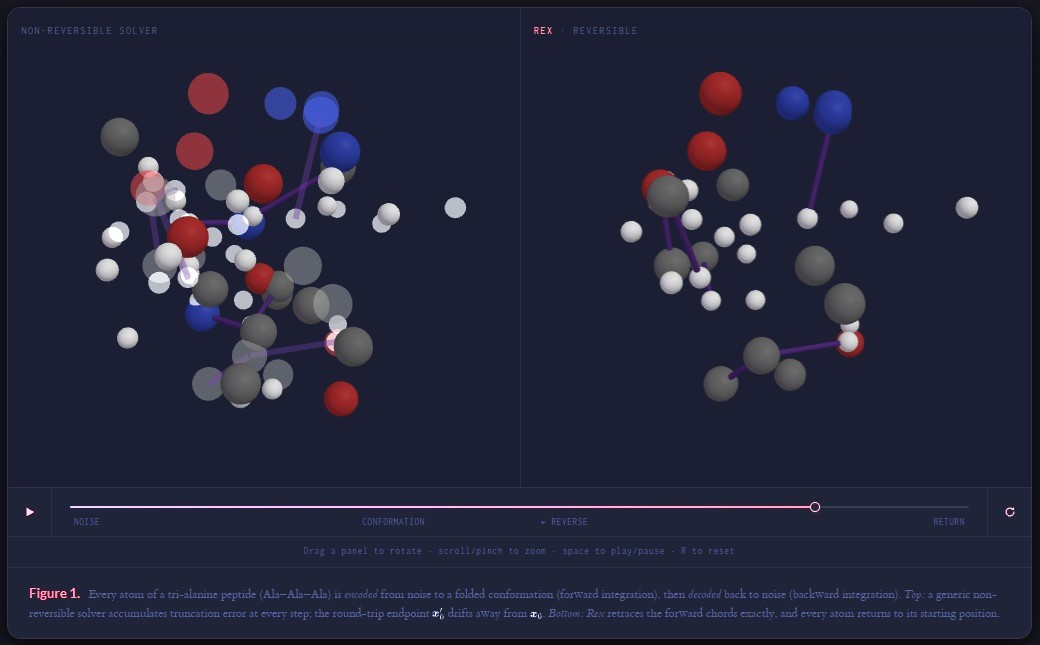
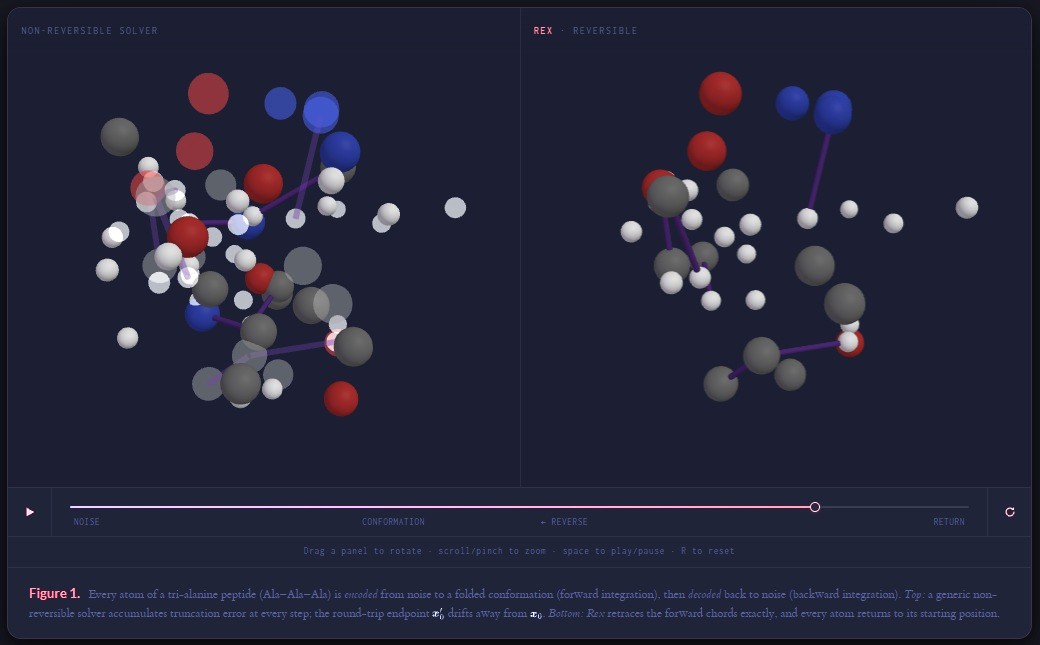
Diffusion and flow-matching models are the foundation of many modern generative AI systems, including image generators, molecular design tools and scientific simulators. It works by gradually transforming random noise into useful outputs. While that process is effective for creating new content, many important applications require running it in reverse. Existing methods often introduce errors that make it difficult to accurately recover the original information.
The Clarkson team's Rex framework addresses that challenge by making the forward and backward processes much more closely aligned, allowing AI systems to reverse their steps with significantly greater accuracy.
"One important application of exact-inversion solvers is round-trip image editing," Blasingame said. "While all reversible methods accumulate some numerical error, Rex achieves orders-of-magnitude lower inversion error than competing approaches."
The advance could enable more precise image editing tools, allowing users to modify AI-generated images while preserving important details and maintaining greater control over the final result. Beyond creative applications, the technology could improve molecular simulations used in chemistry and drug discovery, where accurately tracing and modeling complex processes is critical.
Because Rex can be integrated into existing diffusion and flow-matching models, —the approach can be adopted without redesigning entire AI pipelines. That makes it immediately useful to researchers and developers working on next-generation AI applications.
The research builds on a series of studies by Blasingame and Liu exploring diffusion and flow-matching models. It also extends work from the final chapter of Blasingame's doctoral dissertation at Clarkson University. Blasingame, who earned bachelor's, master's and doctoral degrees from Clarkson in 2018, 2020 and 2025, respectively, is now a postdoctoral researcher at AITHYRA in Vienna, Austria.
The research was selected for oral presentation at the International Conference on Machine Learning (ICML 2026), one of the largest annual gatherings of artificial intelligence and machine learning researchers. Blasingame will present the research in Seoul, South Korea, on July 7.
Paper, code and interactive demonstrations are available at rex-solver.github.io. More information about Liu's research group is available at camel.clarkson.edu.